Showing posts with label Banned books. Show all posts

Monday, April 9, 2012

The Top Ten Most Frequently Challenged Books of 2011

The American Library Association (ALA) has released its annual list of the most frequently challenged books of the year. During the past year the ALA Office for Intellectual Freedom received 326 reports of attempts to remove or restrict materials from school curricula and library bookshelves. The list is part of the ALA's 2012 State of America's Libraries Report which was released to coincide with National Library Week (April 8-14). The top ten most frequently challenged books of 2011, and their reasons are:

1. ttyl; ttfn; l8r, g8tr (series) by Lauren Myracle for Offensive language; religious viewpoint; sexually explicit; unsuited to age group


2. The Color of Earth (series) by Kim Dong Hwa for nudity; sex education; sexually explicit; unsuited to age group


3. The Hunger Games trilogy by Suzanne Collins for insensitivity; offensive language; violence; occult/satanic; being anti-ethnic; anti-family


4. My Mom's Having a Baby! A Kid's Month-by-Month Guide to Pregnancy by Dori Hillestad Butler for nudity; sex education, sexually explicit; unsuited to age group


5. The Absolutely True Diary of a Part-Time Indian by Sherman Alexie for offensive language; racism; religious viewpoint; sexually explicit; unsuited to age group


6. Alice (series) by Phyllis Reynolds Naylor for nudity; offensive language; religious viewpoint. Here are cover images of the first three, the 25th book in the series is set for release in 2013.


7. Brave New World by Aldous Huxley for insensitivity; nudity; racism; religious viewpoint; sexually explicit


8. What My Mother Doesn't Know by Sonya Sones for nudity; offensive language; sexually explicity


9. Gossip Girl (series) by Cecily Von Ziegesar for drugs; offensive language; sexually explicit. Here are the cover images for the first three.


10. To Kill a Mockingbird by Harper Lee for offensive language; racism


The State of America’s Libraries Report documents trends in library usage and details the impact of library budget cuts, technology use and the various other challenges facing U.S. libraries.  The full Report is available at http://www.ala.org/news/mediapresscenter/americaslibraries/soal2012.

Happy reading,
Angela


Saturday, October 1, 2011

To Kill a Mockingbird Giveaway

As I sit down at the computer, my house smells like pumpkin pie and fresh coffee. So homey. The smell of pumpkin pie comes from a candle, but I really do have fresh coffee.

We finally have sunshine here after days of rain. Six to be exact. Not quite forty as Noah had to contend with. I don't have to go get any Ark-building supplies. Everything is still pretty soggy. Oh yeah, To Kill a Mockingbird.

Here's an overview of the story:
In the small town of Maycomb, Alabama, in the 1930s, six-year-old Scout Finch and her older brother Jem become the beneficiaries of gifts left by an anonymous giver who deposits them in the hollowed tree outside the Radley house. While Scout and and Jem ponder the identity of their generous secret sharer and his relationship to the reclusive Radley family, their lawyer father, Atticus, is appointed defense attorney for Tom Robinson, a young black man accused of raping a white woman in a case that has brought the town's simmering racial tensions to a boil. Slowly, ineluctably, the worlds of innocence and experience known to the members of the Finch family come into violent collision, shaking their beliefs in the inevitability of justice and the ultimate triumph of truth over hypocrisy and prejudice.

A modern American classic that won the Pulitzer Prize for fiction in 1961 and served as the basis for the Academy Award-winning film starring Gregory Peck, Harper Lee's To Kill a Mockingbird has never been out of print in the more than half-century since it was first published.
To Kill a Mockingbird by Harper Lee is one of my favorite books. It's also one of the most frequently challenged classics. From ala.org:
Challenged in Eden Valley, MN (1977) and temporarily banned due to words "damn" and "whore lady" used in the novel. Challenged in the Vernon Verona Sherill, NY School District (1980)  as a "filthy, trashy novel." Challenged at the Warren, IN Township schools (1981) because  the book does "psychological damage to the positive integration process" and "represents  institutionalized racism under the guise of good literature." After unsuccessfully trying to ban Lee's novel, three black parents resigned from the township human relations advisory  council. Challenged in the Waukegan, IL School District (1984) because the novel uses the  word "nigger." Challenged in the Kansas City, MO junior high schools (1985). Challenged at  the Park Hill, MO Junior High School (1985) because the novel "contains profanity and  racial slurs." Retained on a supplemental eighth grade reading list in the Casa Grande, AZ  Elementary School District (1985), despite the protests by black parents and the National  Association for the Advancement of Colored People who charged the book was unfit for junior high use. Challenged at the Santa Cruz, CA Schools (1995) because of its racial themes.  Removed from the Southwood High School Library in Caddo Parish, LA (1995) because the book's language and content were objectionable. Challenged at the Moss Point, MS School District (1996) because the novel contains a racial epithet. Banned from the Lindale, TX advanced placement English reading list (1996) because the book "conflicted with the values of the community." Challenged by a Glynn County, GA (2001) School Board member because of profanity. The novel was retained. Returned to the freshman reading list at Muskogee, OK High School (2001) despite complaints over the years from black students and parents about racial slurs in the text. Challenged in the Normal, IL Community High School's sophomore literature class (2003) as being degrading to African Americans. Challenged at the Stanford Middle School in Durham, NC (2004) because the 1961 Pulitzer Prize-winning novel uses the word "nigger."  Challenged at the Brentwood, TN Middle School (2006) because the book contains “profanity” and “contains adult themes such as sexual intercourse, rape, and incest.”  The complainants also contend that the book’s use of racial slurs promotes “racial hatred, racial division, racial separation, and promotes white supremacy.”  Retained in the English curriculum by the Cherry Hill, NJ Board of Education (2007).  A resident had objected to the novel’s depiction of how blacks are treated by members of a racist white community in an Alabama town during the Depression.  The resident feared the book would upset black children reading it.  Removed (2009) from the St. Edmund Campion Secondary School classrooms in Brampton Ontario, Canada because a parent objected to language used in the novel, including the word “nigger."
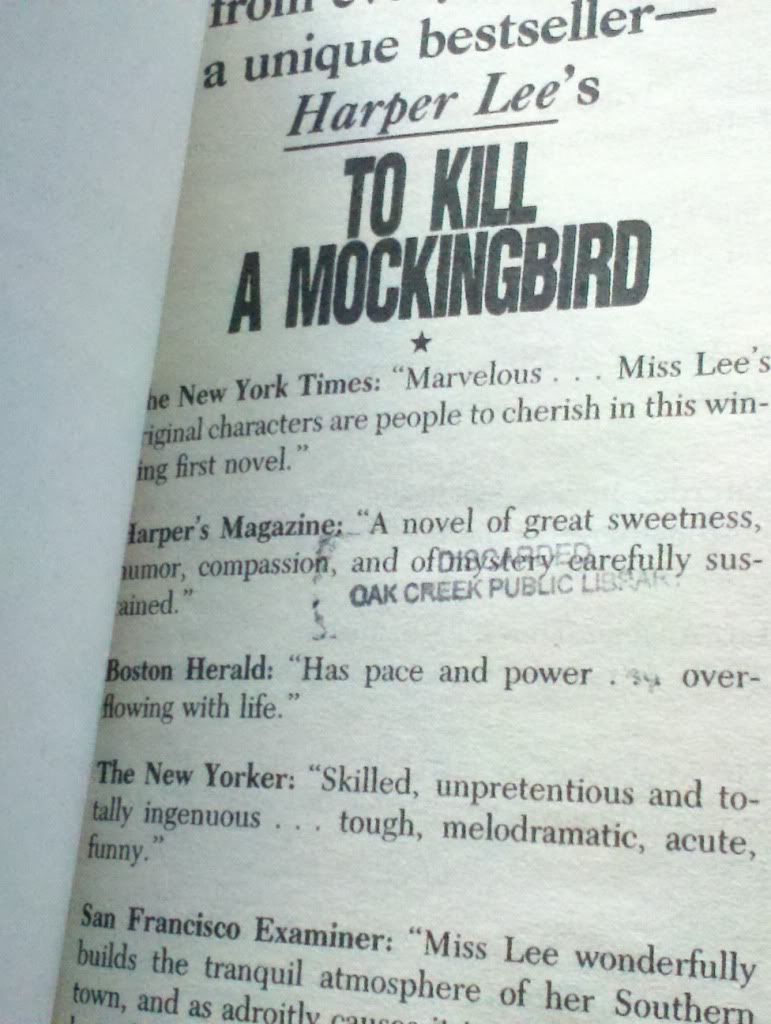
For the last day of banned books week, and because I was able to pick up a nice, gently read copy yesterday. I want one of you to have it. There's no writing, highlighting, or dog-eared pages. The only flaw I noticed was a small library discard stamp that you can see in the photo below. The cover shows light shelf wear with NO spine-creasing. Here are the photos:


If you're interested in having this book, just say so in the comments. Anonymous comments will not be counted. I'll select a winner randomly, and announce it Monday at noon Central time.

Happy reading,
Angela


Thursday, September 29, 2011

Banned Books Week 2011


We are in the midst of Banned Books Week (September 24-October 1). Read-Out events (reading of banned books in public) have been integral in the celebration of intellectual freedom. But this year is special in that, for the first time, everyone can let their voices be heard in one place (YouTube).  Here's where you can get the details on how to participate.

Banned Books Week was started in 1982 by the American Library Association, the American Booksellers Association, the Association of American Publishers and the National Association of College Stores to raise awareness of censorship problems in the US and abroad. For over 25 years, it has remained the only national celebration of the freedom to read. In 2011, the American Society of Journalists and Authors, Comic Book Legal Defense Fund, National Council of Teachers of English, and PEN American Center signed on as co-sponsors of the event.

Held during the last week of September, Banned Books Week highlights the benefits of free and open access to information while drawing attention to the harms of censorship. Intellectual freedom which is the freedom to access information and express ideas, even if the information and ideas might be considered unorthodox or unpopular, provides the foundation of Banned Books Week.

Banned and/or Challenged Classics How many of these have you read? And loved?

Frequently Challenged Books

Protect your rights to read what you wish, and for others to do the same. You alone have the distinct responsibility to allow or disallow what your children can read.

Go ahead, read a banned book if you want to. It's your right.

Angela


Related Posts Plugin for WordPress, Blogger...